Why alignment matters beyond appearance
Crowded and rotated teeth are harder to clean. Plaque collects in the overlaps that a brush and floss cannot reach properly, which raises the risk of decay and gum inflammation in exactly the places you cannot see.
A bite that does not meet evenly concentrates force on a few teeth rather than spreading it across all of them. Over years that shows up as wear, chipping, sensitivity, and sometimes jaw joint discomfort.
This is why an orthodontic assessment looks at how your teeth meet, not only how they line up when you smile.
Clear aligner therapy
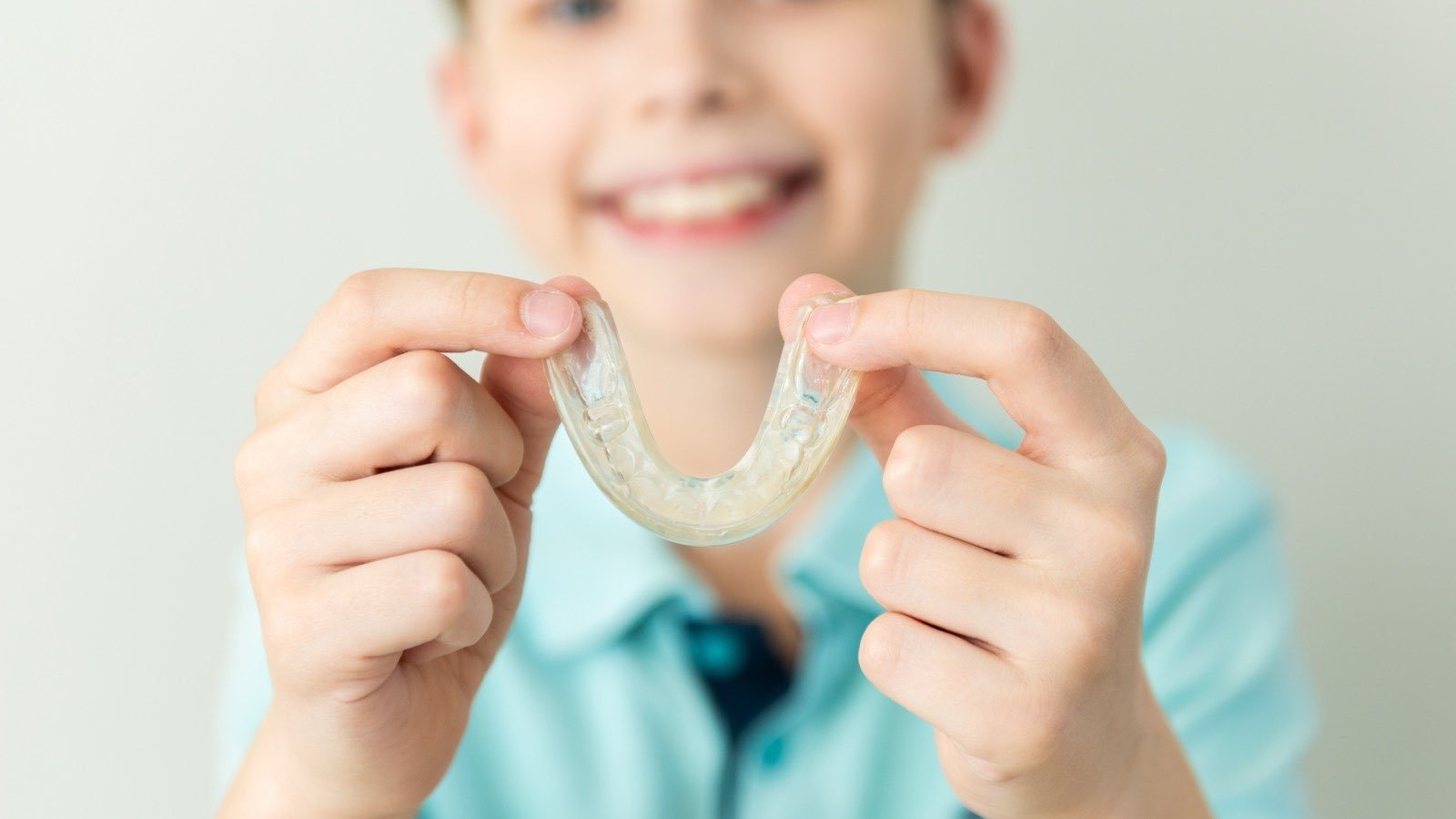
Clear aligners are a series of removable transparent trays. Each is worn for one to two weeks and moves teeth a small, planned amount before you progress to the next in the sequence.
- Removable for eating and cleaning — you brush and floss normally, with no brackets or wires in the way
- Visually discreet — the main reason many adults choose them
- Planned digitally — a scan maps the movement sequence from start to finish before the first tray is made
- Dependent on wear time — they need roughly 20 to 22 hours a day to work, and treatment stalls if they are not worn
Aligners handle mild to moderate crowding, spacing and many bite corrections well. Complex movements — significant rotations, large vertical changes, some skeletal discrepancies — are often better served by fixed braces. We will tell you plainly which category your case falls into.
Fixed braces
Fixed braces bond a bracket to each tooth and connect them with a wire that is adjusted over the course of treatment. Because they are attached, they work continuously and do not depend on you remembering to wear them.
Metal brackets
The most efficient option across the widest range of cases, and generally the most economical.
Ceramic brackets
Tooth-coloured brackets that are considerably less visible than metal. They are somewhat more fragile and require a little more care with hard foods.
Braces demand more attention to cleaning, since brackets and wires create places for plaque to gather. Our at-home oral hygiene guide covers the technique in detail.
Early assessment for children
Canadian and international guidance suggests an orthodontic assessment around age seven. That is not because treatment usually starts then — most children need nothing at that stage — but because it is the age at which developing problems become visible while the jaw is still growing.
- Crowding that is clearly going to worsen as permanent teeth arrive
- Crossbites, which can shift jaw growth if left
- Significant overbite or underbite
- Habits such as thumb sucking that are affecting tooth position
- Teeth lost early or retained too long, affecting the space available
Where something is developing, intervening while growth is still happening can be simpler than correcting it after. Where nothing is, we monitor and tell you so. See our children’s dental health guide for milestones by age.
Retainers — the part people skip
Teeth move throughout life. The fibres that hold them have elastic memory, and without retention they drift back toward where they started. Relapse after successful orthodontic treatment is common, and almost always down to retainers not being worn.
- Fixed retainers — a thin wire bonded behind the front teeth, working permanently without you thinking about it
- Removable retainers — clear retainers worn nightly, long term
- Often both — a fixed wire on the lower front teeth with a removable retainer above is a common combination
Retention is not a short phase at the end of treatment. Plan on wearing something, at least at night, indefinitely.
Orthodontics FAQ
How long does orthodontic treatment take?
+Most comprehensive cases run twelve to twenty-four months. Minor corrections can be considerably shorter. The honest answer for your case comes after we have assessed your bite and taken records — anyone quoting a timeline before that is guessing.
Are clear aligners as effective as braces?
+For mild to moderate cases, aligners achieve comparable results. For complex movements, fixed braces still have the advantage. Aligners also depend entirely on being worn 20 to 22 hours a day — if that is unrealistic for you, braces will produce a better outcome.
Am I too old for orthodontic treatment?
+No. Teeth move at any age, provided the supporting bone and gums are healthy. Adults make up a growing share of orthodontic patients. Existing gum disease needs to be treated and stable before starting.
Does orthodontic treatment hurt?
+Expect a few days of tenderness after the appliance is fitted and after each adjustment or tray change — a dull ache when biting, rather than sharp pain. It settles as teeth adapt, and over-the-counter pain relief is usually enough.
When should my child first be assessed?
+Around age seven. Most children need no treatment at that point, but it is when developing bite problems become apparent while the jaw is still growing and easier to guide.